
You know what to do.
Hindigo helps you start.
A blocked intention becomes a tiny, immediately actionable step, calibrated to your current energy. Never a list. Never a choice to make. Only one hindigo visible at a time.
Only 4 spots left
It's not a lack of tools. It's a task initiation problem.
Knowing what to do has never been the problem. The blockage occurs before that—at the moment of starting. Traditional planners demand the very act that paralyzes: sitting down, organizing, choosing where to begin. They add a step to an already stalled engine.
Hindigo doesn't ask you to organize anything. It removes the decision: each time you open it, one tiny step, calibrated to what you have at hand right now—not to what you ideally should be able to do.
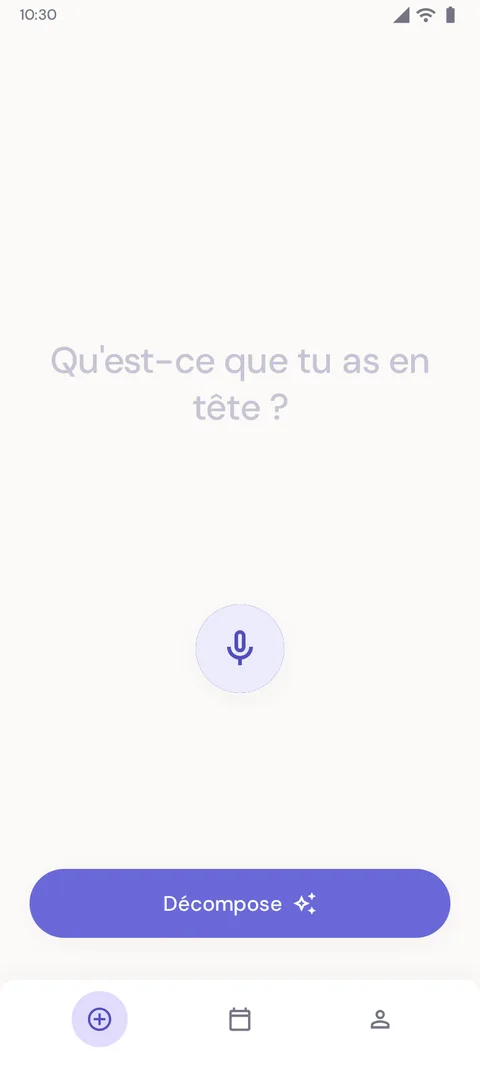
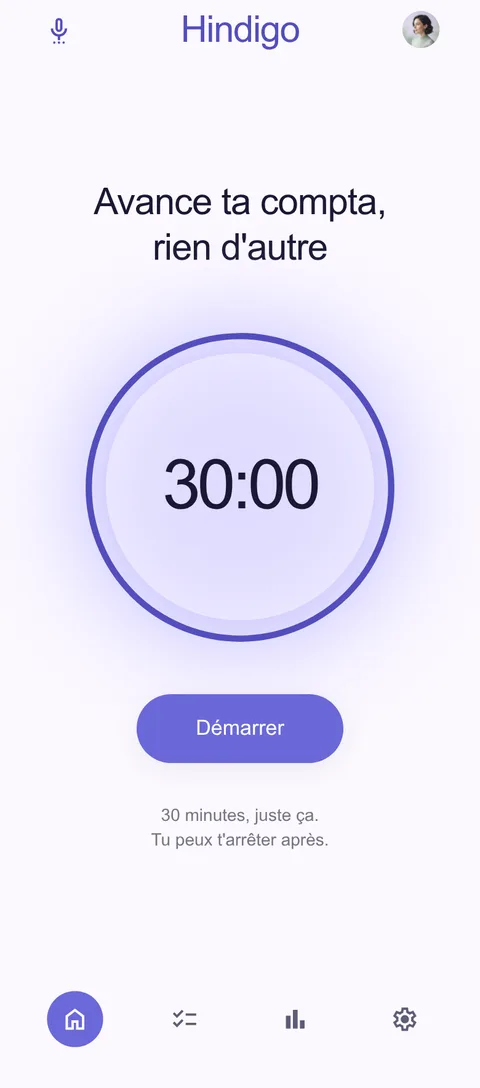
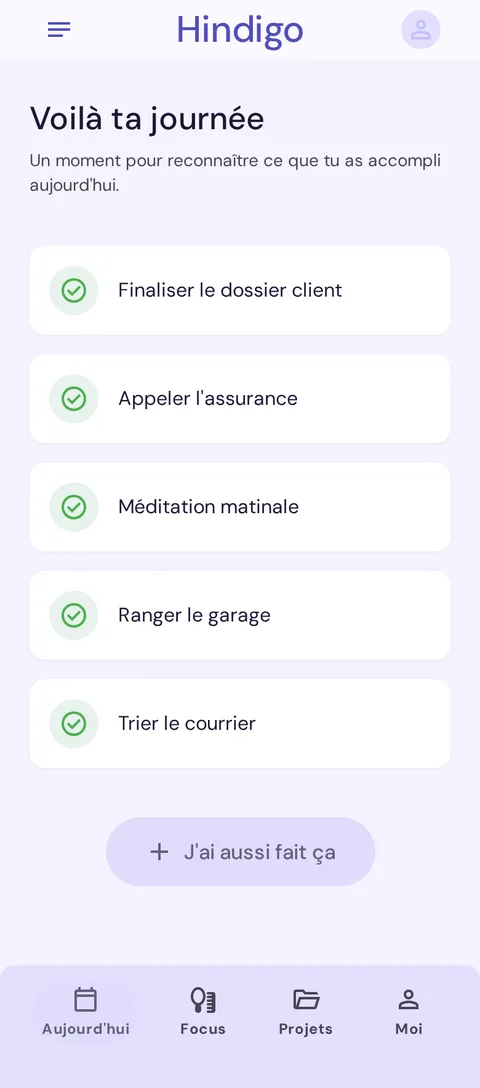
Four screens. Never more than one thing visible.
Capture
You say or type what's blocking you—roughly, without formalizing it. No specific formatting is required.
Calibration
Hindigo calibrates a step to your current energy—not to a deadline or a method.
Result
A single step appears. Not a list, not a plan, not a choice to make between multiple options.
Execution
You start it, right now. The next step only appears once this one is done.
What it looks like


Anti-shame isn't a tone. It's a mechanism.
The longer an intention lingers, the more shameful it becomes to do, the more it's avoided. Hindigo breaks this cycle—not just a lack of motivation.
No forced lists
The main path never shows an entire sequence at once. One step, never another to-do list.
No shame colors
Never red, never an X, never a late badge—even in views showing what's in progress.
Nothing counts elapsed time
No mention of '3 weeks ago' or 'finally.' An intention set aside remains retrievable, never a failure.
Flat days are welcomed
'Off day, okay'—no excuse needed. Opening the app without accomplishing anything still holds value.

Not just another productivity app
Four mechanisms other apps don't have
Roulette
When deciding WHERE to start is exactly what's blocking you, one button picks a task for you — the decision itself no longer needs you.
Departure Mode
Before a fixed-time appointment, the app counts backward to work out when to leave, and when to start getting ready — not just a reminder at the appointment time.
Co-piloting
Someone you choose can see your next step and support you — external pressure acts as a starting trigger, when willpower alone isn't enough.
Cross-session memory
What you set aside yesterday is waiting for you today, without having to re-enter everything.
What we're asked most often
How do I stop procrastinating on a task that's blocking me?
Generally, the problem isn't motivation but the size of the first step. Hindigo reduces the task to a single, tiny, immediately actionable step, calibrated to your current energy—not to a method or a deadline. Once that step is done, the next one appears.
Am I procrastinating, or do I have ADHD?
Everyone procrastinates sometimes—it becomes a real signal when the blockage affects almost all tasks, even simple, low-stakes ones, and traditional organizational methods haven't changed anything for a long time. This is neither a diagnosis nor a replacement for medical advice, but Hindigo is designed to help in both cases: the task initiation mechanism it removes is the same, whether the blockage stems from ADHD or not.
Is there an app designed for ADHD and starting block?
Yes: Hindigo is specifically designed for task initiation, a central challenge in ADHD (executive functions). The app doesn't diagnose anything and isn't a substitute for medical supervision—it's a tool that removes the decision at the moment of starting.
What's the difference between a to-do list and Hindigo?
A to-do list shows everything at once and forces you to choose where to start—it's often that choice that causes the block. Hindigo never displays a list: only one step is visible at a time, never an entire plan.
Is Hindigo a coach or therapy?
No. Hindigo is a tool, not a coach or therapy, and makes no therapeutic promises. It solely addresses the friction of starting an already identified task.
On which platforms is Hindigo available?
Hindigo is currently in testing on Android (native Kotlin), with an open list of evaluators before public release. There is no iOS app or web version beyond this showcase site yet.
Join the last 4 testers and get a year free.
In exchange for real feedback on what we improve, evaluators who join now keep Hindigo free for a year after the public launch.
Or follow our progress on the blog — no spam, no marketing sequence.